

With a deep crisis facing NHS recruitment and retention, our team of representatives gave oral evidence to the Review Body on Doctors’ and Dentists’ Remuneration (DDRB) in late November, robustly setting out the case for a fair NHS pay rise for 2026-27.
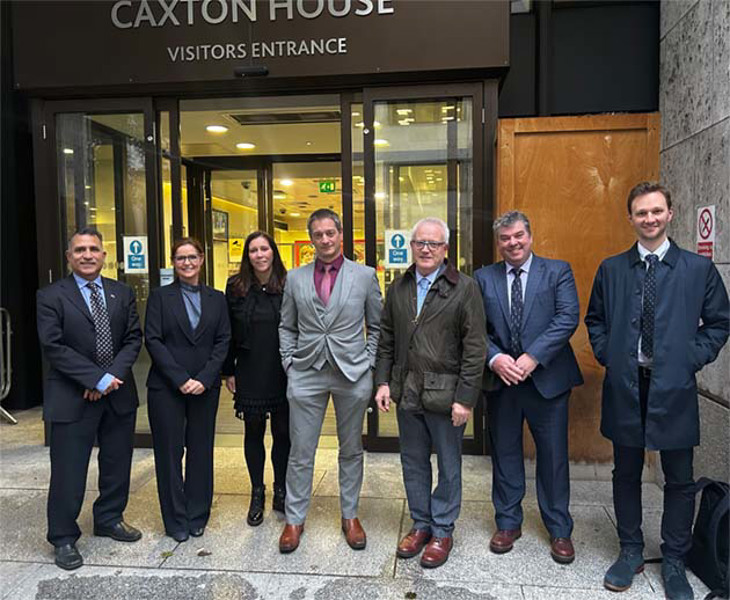
The BDA team: Shiv Pabary (GDPC), Ciara Gallagher (NIDPC), Christina Ferry (SDPC), Russell Gidney (WGDPC), Peter Crooks (PEC), Phil MacCallum (CDS/PDS), and Jeremy Boyles (YDC).
Given the long-term erosion of the real value of NHS pay for dentists, it is little wonder that only 7% of heavily-committed NHS practice owners feel their pay is fair, and the figure is 29% for associates. This goes a long way to explaining the deep challenges with recruitment and retention, and why morale is at rock bottom.
The impact of this crisis on patients is profound. In Northern Ireland, NHS patient registrations are down 24%, and the number of key treatments like fillings and extractions are down significantly too. In England, 14 million adults are without access to an NHS dentist.
This opportunity to make these points in person followed our written evidence to the DDRB for 2026-27, submitted in September, which sets out – in some depth – the scale of the crisis facing NHS dentistry and the need for a decent, above-inflation pay rise.
Giving evidence alongside me, we had representation from the General Dental Practice Committee (GDPC), and each of the Dental Practice Committees for Northern Ireland, Scotland and Wales, the Community Dental Services (CDS), Public Dental Services (PDS), and the Young Dentists Committee (YDC).
Failure to progress existing recommendations
I had to start by updating the panel on the lack of progress made with the DDRB’s existing recommendations for 2025-26. The Review Body had said that the governments should develop an ‘index of dental costs’, acknowledging that dentists’ pay cannot be untied from the costs of delivering NHS dental treatment. To date, no government has implemented this recommendation.
The same is true for the CDS and PDS, where the DDRB said there was a need for a review of the pay structure and progression within it. No government has indicated it is willing to have that conversation.
On the substantive issue of the pay rise and contract uplift for 2025-26, the Department of Health and Social Care have applied an uplift to dentists’ operating costs of just 2.39%. This comes nowhere near addressing the increases in practice overheads from lab bills to energy costs, leading to an effective pay cut, not a pay rise. The Government says that it cannot afford a higher uplift, but it must realise that if it cannot afford the costs of NHS dentistry, then dentists certainly cannot.
The Scottish Government once again has not applied the uplift to all the allowances, thereby undermining the DDRB’s recommendation.
The Welsh Government – yet again - wants to apply conditions to the recommended uplift. Completely ignoring the DDRB, which has said that “it is unhelpful if DDRB recommendations become the starting point for further negotiations”. We entirely agree.
In Northern Ireland, the Health Minister is taking some of next year’s budget and applying it to this year’s departmental shortfall so he can implement the recommended uplift. The Consumer Prices Index including owner occupiers' housing costs is being applied to determine expenses, resulting in an overall uplift of 4.04%.
Of course, the costs of providing care have also increased further this year because Employer’s National Insurance, the National Minimum Wage and the National Living Wage have all increased. These are set to rise further following the latest Budget.
While the detail is different across the UK, the effect is the same. Governments are failing to meet the costs of providing NHS dentistry, leaving dentists to pick up the bill by cutting their pay and potentially increasing their private work.
The recruitment and retention crisis
Despite there being more than 46,000 dentists registered with the GDC, the NHS is unable to secure sufficient workforce, and – alongside the NHS contracts – the real-terms cuts to pay are a significant factor in this. In England, there are only 11,000 full-time equivalent dentists working in the NHS.
With both associates and practice owners on our panel of representatives, we were able to give both perspectives on the nature of recruitment and retention in NHS dentistry. Our research shows that nearly every heavily-committed NHS practice that tried to recruit staff experienced difficulties doing so.
In England, there is an NHS dental vacancy rate of 19%, compared to a 6.9% rate reported for the NHS as a whole. Meanwhile, 22% of associates looked for a new role last year, often moving practice in search of better pay.
Ciara Gallagher, Chair of the Northern Ireland Dental Practice Committee (NIDPC), set out that across all of the criteria associates consider when looking for a role – pay, working environment, work-life balance – the NHS comes out unfavourably. The DDRB has the opportunity to recommend an increase in NHS pay and an increase to funding so practices can invest adequately in their working environment.
The DDRB plays a critical role in ensuring that NHS work is attractive and financially viable. They cannot let the profession, and our patients, down.
Stabilising NHS dentistry
In its recommendations on pay this year, the DDRB has the opportunity to send a clear message that NHS dentistry has a future, and recommending an above-inflation pay increase would help to provide much needed stability to the service.
It also must ensure that governments are not let off the hook on the full costs of delivering care. The governments must stop undermining the DDRB’s recommendations so that a pay rise means just that.
If the DDRB shirks its responsibility, then NHS dentistry will continue its precipitous decline.