
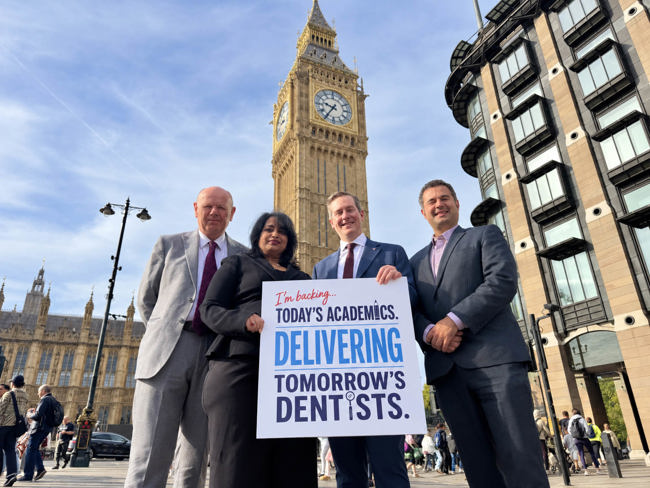
(left to right) BDA Chair Eddie Crouch joins Dental Academic Staff Committee (DASC) Vice Chair Swati Nehete, Chris Vernazza from the Dental Schools Council, and DASC Chair Petros Mylonas
We are asking Government to safeguard the future of dental training and the NHS dental workforce.
Petros Mylonas and Swati Nehete, from our Dental Academic Staff Committee, met with cross party MPs from across the UK, and highlighted concerns that shortages in the dental academic workforce are affecting our ability to train the next generation of dentists.
Our key asks include a dedicated workforce review of dental academia, an increase in investment and a commitment to protect funding streams, and the need to develop evidence-based guidance on safe staff-to-student ratios.
“The message from our members is clear," said Petros. "Unless our academic workforce is better supported, we stand to lose a critical mass of expertise across research, education, and clinical leadership in dentistry.
“Failure to act here risks completely derailing dental education.
“If UK governments don’t value today’s dental academics, there is simply no way of training tomorrow’s dentists.”
Recruitment and retention in the dental academic workforce are at a flash point. Since 2024, the number of clinical teachers in the UK has reduced by 25%, professors by 18%, and lecturers by 13%.
There are now twice as many dental academics over 55, as there are under 36 years old, with more than a quarter of clinical academics now over the age of 55. Our members are highlighting their concerns over growing gaps in expertise, with an ageing workforce and both recruitment and retention problems.
Political and financial pressures are also contributing to a perfect storm for dental academia. Academic staff are now being asked to train an additional 50 dentists per year from 2027. Reductions in administrative support, and cuts to Strategic Priorities Grant funding are adding to the strain academics are experiencing.
Many of our members cite increasing workload pressures, including widespread reports of unpaid overtime: 90% of academics say they are regularly working beyond their contracted hours, and 85% say they are not getting paid for this, and are not being offered time off in lieu.
While two new dental schools have been confirmed at the University of East Anglia (UEA) and University of Portsmouth, each receiving 25 new dental training places we have stressed that there isn’t even a workforce to deliver on this modest increase in student numbers, and a funded plan to support dental academia must underpin this and any future expansion.
We have stressed that there isn’t even a workforce to deliver on the modest increase in student numbers recently confirmed by government, and a funded plan to support dental academia must underpin this and any future expansion.
We will continue to raise these issues with key stakeholders, and ensure we have a robust and valued dental academic workforce. We are keen to hear from dental academics on the pressures you are facing, please get in touch.