
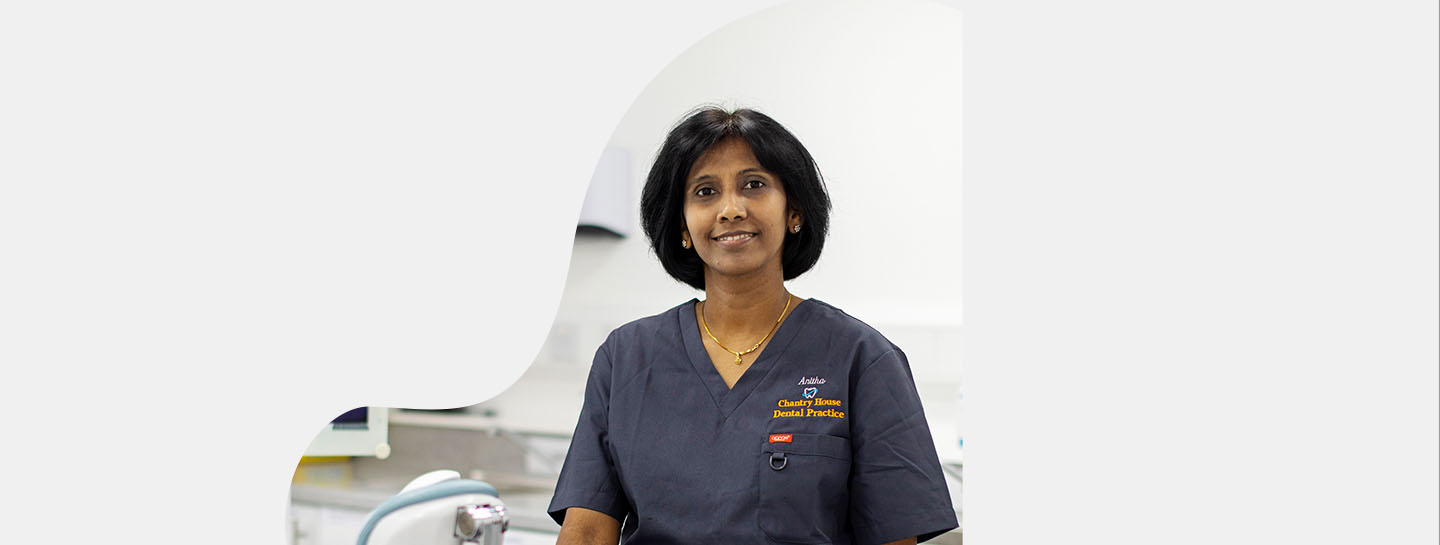
An Indian dentist's journey from shadowing to surgery
Anitha Diwakar, principal dentist and Clinical Director at Chantry House Dental Practice
After qualifying as a dentist in India, Anitha Diwakar progressed her dentistry career across disciplines, roles and nations in the UK.
When Anitha Diwakar became a dentist in 1999, she wanted to embrace the career opportunities available in dental surgery.
“I qualified in India and worked there for over a year afterwards. First I did an internship at an orthodontic practice, and then continued working there as an associate in the evenings while lecturing undergraduates at a hospital during the day.”
Anitha got married in India, she and her husband moved to the UK in 2001.
“When we came here I thought it would be a great opportunity to see what I could do professionally. Relocating to the UK was exciting and daunting. I wanted to get into a hospital as a first step, just to see how things work here.”
As a long-term plan, Anitha wanted to improve her surgical skills.
“It was always my intention to gain Membership of the Faculty of Dental Surgery (MFDS), but the journey to achieving it was always going to be a challenge.”
Making her ambitions a reality
Anitha visited some local hospitals and started working at Old Church Hospital in Romford.
“It was a shadowing position and the consultant was very happy for me to observe the clinical side of things. The procedures were mainly maxillofacial and I did not touch the patients.”
After a while, Anitha enquired about pathways to be able to do more.
“I went through the whole process of occupational health, HR and getting all my vaccinations.”
Once she cleared that, Anitha was able to assist in the maxillofacial unit of the hospital.
“During surgical procedures I could scrub, decontaminate, and pass instruments between the nurse and the clinician. So I was not actually treating patients but I was in that environment, I could be part of the team.”
"After I passed the English language examination, I completed MFDS part A, and was able to get involved in the clinical side of dentistry a bit more.”
Anitha says she was very fortunate to be able to work as a locum in the maxillofacial unit before getting a position in Scotland.
“In Dumfries and Galloway I worked as a Senior House Officer (SHO) for a while, with temporary GDC registration, before moving back to Essex. I continued doing SHO positions for quite a significant length of time to get my MFDS under my belt and do what is now called the Overseas Registration Exam (ORE).”
After having passed the ORE, Anitha applied for vocational training in the local deanery and trained in the South East of England.
“I worked as an associate in a couple of practices, obtained my diploma in Restorative Dentistry with the Faculty of General Dental Practice (FGDP), England and in 2018 I purchased my own practice.”
Although the route she chose took time, Anitha says the experiences she had along the way were very valuable.
“As an undergraduate you only get to do so many surgical cases, and I was really able to learn a lot in hospitals. I worked with a great bunch of people and good teachers, and I was able to prepare for the ORE at the same time.”
Meeting other dentists and building a network in the UK
Reflecting on her winding career path, like many dentists from overseas, adjusting to working life in the UK was a gradual process for Anitha. At times, she found it difficult to know where to turn to for support.
"It took me a good year or two to get used to the accent and understand how things are pronounced. Also, the speed at which one communicates can be very different. It takes time to settle in with the weather and culture.”
Professional courses often provide welcome opportunities for sharing experiences, networking, and making friends.
“While I was doing the ORE and Basic Life Support course, I was able to connect with other people from overseas. There were other dentists from India, and all over the world including Pakistan, Nigeria and Australia.”
Anitha says that another good way to meet dentists from abroad and from the UK is attending Local Dental Committee events.
Finding the BDA
“When I was new to the UK I did not know about deaneries or the BDA so it was not clear to me who to contact for information - I stumbled upon situations and found out how to do things as time went on. Doing it like that was a difficult path but I learned along the way.”
Anitha’s first contact with the BDA came when she transitioned out of hospital dentistry, which meant she was faced with different responsibilities.
“The hospital provided the indemnity for clinical negligence claims, but then working in primary care and later as a practice owner I had to organise it myself, so I became more engaged with the BDA.”
As a member, Anitha also appreciates the targeted advice on the business of dentistry.
“The BDA has been really useful for information on practice management, policies and associate contracts. The staff are very helpful so I direct new dentists there.”
Tips for other overseas dentists
Anitha says that it is vital to keep an eye on requirements in UK dentistry.
“Regulations are always changing so you need to keep on top of it and stay aware of what you have to do.”
For those moving to the UK to work in dentistry today, Anitha has one main piece of advice.
"Networking is very important, and a good place to start is definitely BDA membership. You can look for information on the GDC’s website too. These are the two platforms that I always suggest because that is where everything starts and you can get involved from there.”